Safety doesn’t happen by accident—it’s built through consistent communication. And one of the most effective tools for reinforcing a culture of safety is the humble toolbox talk. When teams gather briefly to discuss hazards, procedures, and real-world risks, the impact can be profound. But without strong, well-organized content, these meetings quickly become routine and forgettable. That’s where toolbox talk topics PDFs come in.
These downloadable resources distill critical safety information into structured, easy-to-use formats. They save time, improve consistency, and ensure that nothing vital is missed. Whether you're a safety officer, site supervisor, or project manager, having a reliable library of PDFs means you’re always prepared to lead a meaningful conversation.
Here’s what actually works in the field—based on thousands of real safety meetings and what OSHA and industry leaders emphasize.
Why Quality Toolbox Talk PDFs Matter
Too many teams rely on last-minute, off-the-cuff safety talks. The result? Repetition, vague warnings, and compliance gaps. A well-designed PDF changes that. It turns a five-minute chat into a documented, actionable safety intervention.
Common issues with weak toolbox talks: - Focus on compliance, not behavior change - Lack of visual aids or real examples - No follow-up or sign-in sheet - Too technical or too simplistic
A solid PDF includes: ✔ Clear topic breakdown ✔ Realistic workplace scenarios ✔ Discussion prompts for engagement ✔ Space for attendance and signatures ✔ OSHA-aligned content
The best ones are practical, not theoretical. They’re written for workers on the ground—not just for auditors reviewing binders.
10 High-Impact Toolbox Talk Topics (With PDF Use Cases)
Not all topics are created equal. The most effective talks tackle frequent risks with high injury rates. Here are ten proven subjects, each with real-world applications and why they deserve a dedicated PDF.
#### 1. Personal Protective Equipment (PPE) Every site uses PPE—but misuse is common. A PDF on this topic should cover: - Correct selection for tasks (e.g., face shields vs. safety glasses) - Limitations of gear (e.g., gloves don’t make you cut-proof) - Inspection and replacement cues
Real use case: A crew replacing roofing nails was using gloves meant for general handling. After a toolbox talk on PPE-specific to roofing, they switched to cut-resistant gloves—reducing hand injuries by 70% over two months.
#### 2. Fall Protection at Heights Falls top OSHA’s fatal four. A PDF must go beyond “wear your harness.” It should include: - Anchor point validation - Lanyard swing-fall risks - Rescue planning (many forget this)
Pro tip: Include a site-specific fall zone diagram in your PDF—this turns theory into action.
#### 3. Electrical Safety
- Recognizing damaged cords and tools
- Safe distances from overhead lines
- One-person rule near live circuits
Common mistake: Workers assume GFCI outlets eliminate all risk. Clarify that GFCI reduces shock severity but doesn’t replace de-energizing.

#### 4. Hazard Communication (HazCom) Chemicals are invisible threats. A strong HazCom PDF: - Explains GHS labels and pictograms - Shows where SDS are located onsite - Practices reading safety data sheets
Workplace example: A maintenance team reviewed a HazCom PDF before handling a new degreaser—discovering it required ventilation they didn’t have. They adjusted the plan before starting.
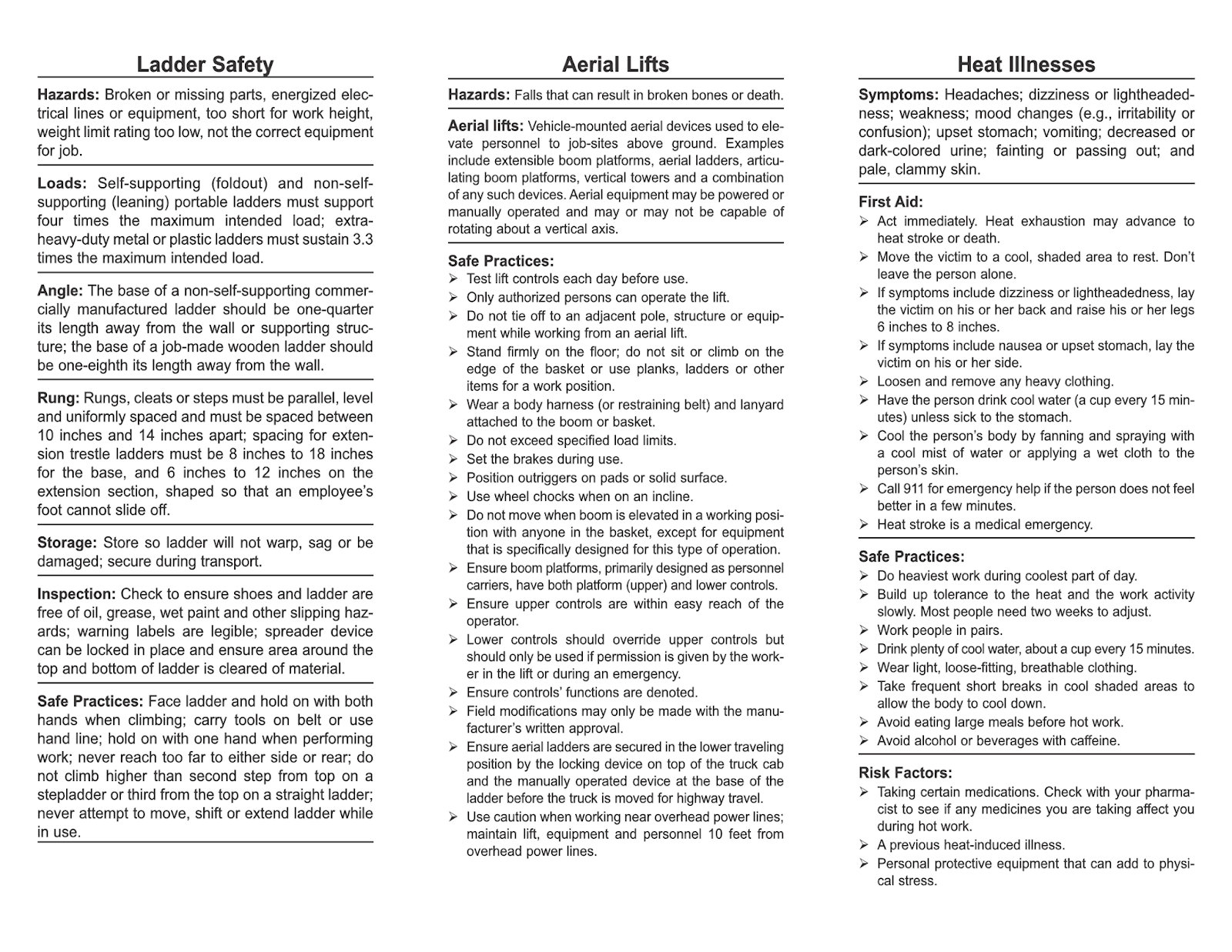
#### 5. Ladder Safety Ladders cause more injuries than many realize. A quality PDF covers: - 3-point contact rule - Proper setup angles (4:1 ratio) - Weight limits and side-loading risks
Limitation: Most PDFs don’t emphasize ladder inspection. Add a checklist to yours.
#### 6. Excavation and Trenching Cave-ins are deadly and preventable. Essential elements: - Soil type recognition (Type A, B, C) - Protective systems (shoring, shielding, sloping) - Daily inspection requirements
Field reality: Many crews skip trench box setup “just for 10 minutes.” Use a PDF to stress that 90 seconds of prep can save a life.
#### 7. Scaffold Safety With over 2.3 million workers using scaffolds, this topic is non-negotiable. Include in your PDF: - Guardrail requirements - Load capacity awareness - Weather-related risks (wind, rain)
Checklist inclusion: Add a quick pre-use scaffold inspection list—workers can tick it off before climbing.
#### 8. Hot Work and Fire Prevention Welding, cutting, grinding—each carries fire risk. A strong PDF should: - Define fire watch duration (30+ minutes post-work) - List combustible material clearance distances - Assign accountability
Real example: After a near-miss fire during welding, a site implemented a hot work PDF checklist—resulting in zero incidents in the next 18 months.
#### 9. Manual Material Handling Back injuries cost employers millions yearly. Your PDF must address: - Proper lifting mechanics (bend knees, keep back straight) - Team lift coordination - Use of mechanical aids
Behavioral tip: Use before-and-after photos in your PDF to show correct vs. incorrect lifting.
#### 10. Slips, Trips, and Falls (Same-Level) Often dismissed, these cause 25% of all workplace injuries. A good PDF: - Identifies common culprits (cords, wet floors, debris) - Encourages immediate housekeeping - Promotes footwear choices
Practical note: Include a “spot the hazard” image in your PDF—great for engagement.
How to Use Toolbox Talk PDFs Effectively
Having a PDF isn’t enough. How you use it determines its impact.
Do: - Print and distribute before the talk - Assign a worker to summarize one point - Keep sign-in sheets for records - Rotate topics weekly
Don’t: - Read the PDF verbatim like a script - Skip discussion—ask “What would you do?” - Use the same topic two weeks in a row - Forget to store completed talks for audits
Workflow tip: Store all PDFs in a shared drive labeled by topic and date. Tag them for searchability (e.g., “fall protection,” “electrical,” “q3-2024”).
Top 5 Sources for Downloadable Toolbox Talk Topics PDFs
| Source | Key Features | Best For |
|---|---|---|
| OSHA.gov | Free, OSHA-compliant, legally vetted | Regulatory alignment |
| SafetyNow | Customizable templates, visual aids | Teams wanting brand consistency |
| Creative Safety Supply | Multilingual, pictogram-heavy | Diverse workforces |
| SafetyTek | Industry-specific (construction, manufacturing) | Niche risk environments |
| Trade Press Sites (e.g., ENR, Safety + Health Magazine) | Real-world case studies, expert insights | High-engagement talks |
Pro tip: Combine templates. Use OSHA’s structure and add visuals from Creative Safety Supply.
What Makes a Toolbox Talk PDF Actually Work?
The best PDFs share common traits: - Scannable layout – Bullet points, bold headers, icons - Action-oriented language – “Inspect before use” vs. “Inspection is important” - Space for customization – Blank fields for site name, date, location - Discussion triggers – “Ask your crew: Have you seen this hazard before?” - Compliance-ready – Includes sign-off section for OSHA audits
Avoid PDFs with dense paragraphs or academic tone. This isn’t a textbook—it’s a field tool.
Building Your Own Toolbox Talk PDF Library
Start with the top 5 topics your team faces most. Download 2–3 versions from different sources. Edit them to match your site’s language, risks, and equipment.
Editing checklist: - Replace generic images with site photos - Add your company logo and safety slogan - Insert local emergency contacts - Include a QR code linking to your full safety manual
Once you have 10 solid PDFs, rotate them on a schedule. Revisit each every 3–6 months—repetition with variation builds retention.
Closing: Make Safety Stick
Toolbox talk topics PDFs aren’t just paperwork—they’re the backbone of a living safety culture. The right PDF turns a routine meeting into a moment of real awareness. It gives supervisors confidence, workers clarity, and companies protection.
Don’t settle for flimsy templates or last-minute scribbles. Invest in quality, clarity, and consistency. Download, customize, and deploy PDFs that reflect the risks your team actually faces. Because when the talk ends, the work—and the danger—doesn’t.
Start building your library today. One well-run toolbox talk can prevent a lifetime of regret.
FAQ
What are the most common toolbox talk topics? PPE, fall protection, electrical safety, ladder use, and hazard communication are consistently top-rated due to high incident rates.
Are toolbox talk PDFs OSHA compliant? Yes, if they cover OSHA-mandated subjects and include documentation like sign-in sheets.
Can I customize toolbox talk PDFs for my site? Absolutely. Customization improves relevance and engagement—add site photos, roles, and equipment details.
Where can I get free toolbox talk PDFs? OSHA.gov offers free, compliant templates. Trade associations and safety magazines also provide downloadable versions.
How often should toolbox talks be held? Weekly is ideal, but monthly minimum. High-risk environments should meet more frequently.
Should toolbox talks be documented? Yes. Signed attendance sheets in PDFs serve as legal proof of training during inspections.
Can toolbox talks reduce workplace injuries? Yes. Studies show regular, meaningful safety talks reduce incidents by up to 40% when combined with follow-up actions.
FAQ
What should you look for in Top Toolbox Talk Topics PDFs for Workplace Safety? Focus on relevance, practical value, and how well the solution matches real user intent.
Is Top Toolbox Talk Topics PDFs for Workplace Safety suitable for beginners? That depends on the workflow, but a clear step-by-step approach usually makes it easier to start.
How do you compare options around Top Toolbox Talk Topics PDFs for Workplace Safety? Compare features, trust signals, limitations, pricing, and ease of implementation.
What mistakes should you avoid? Avoid generic choices, weak validation, and decisions based only on marketing claims.
What is the next best step? Shortlist the most relevant options, validate them quickly, and refine from real-world results.